Infrastructure Through Uncertainty: Reflections from IFB 2016
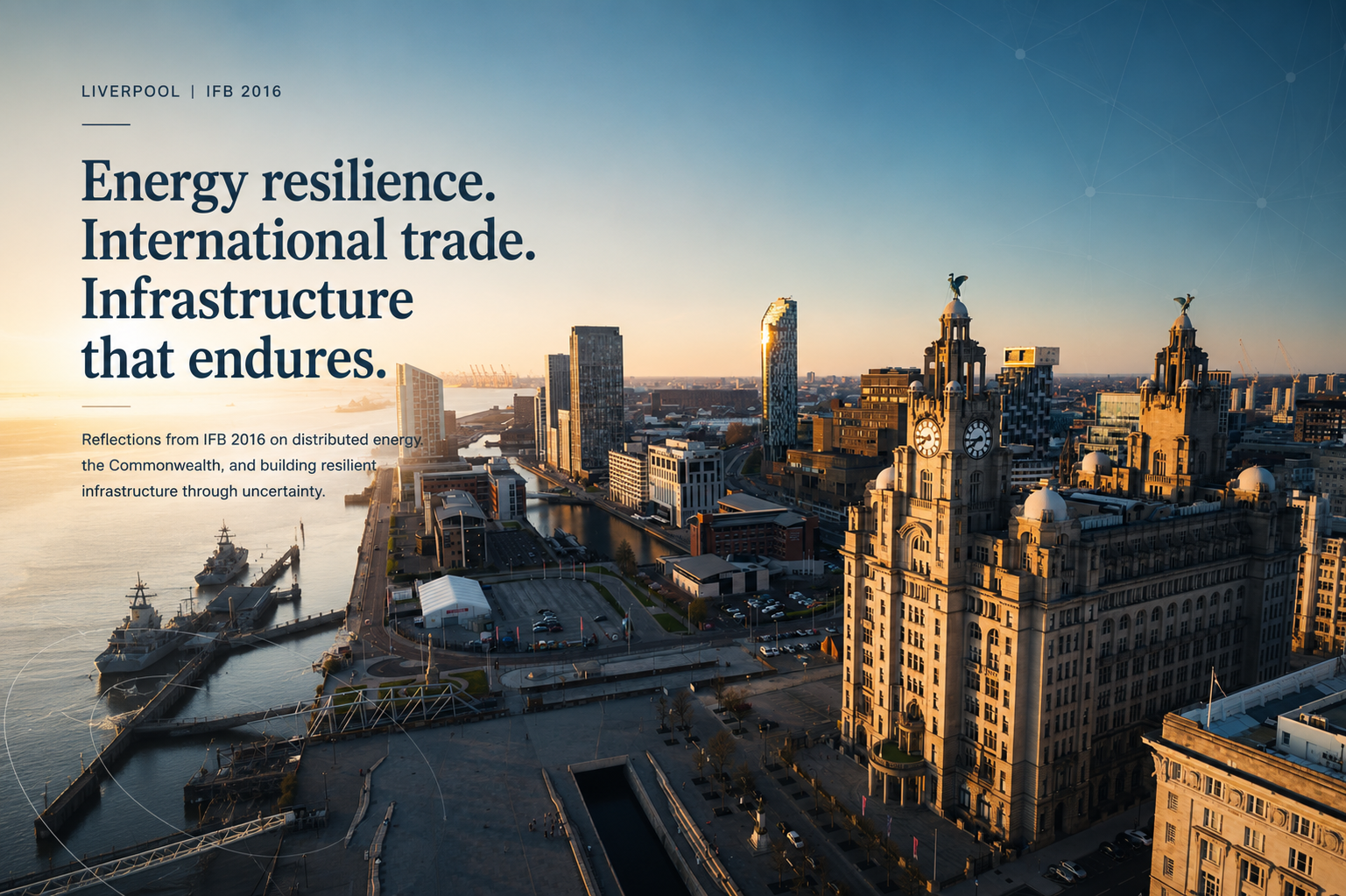
Last week’s International Festival for Business in Liverpool took place during one of the most politically and economically uncertain moments the UK has experienced in recent years.
Only days earlier, the country voted to leave the European Union.
Across the festival there was a visible sense of uncertainty. Conversations moved quickly from trade and investment opportunities to questions around currency volatility, future market access, and what Brexit might ultimately mean for British industry internationally.
Against that backdrop, it was nevertheless encouraging to see the level of optimism and outward-looking ambition still present across the event.
One of the highlights personally was the opportunity to be introduced to Her Majesty Queen Elizabeth II during the festival, following Clarke Energy’s international growth and previous recognition through the Queen’s Award for Enterprise in International Trade.
During our brief discussion, Her Majesty asked about Clarke Energy’s projects in Australia, particularly the delivery of resilient distributed power systems supporting remote mining and oil & gas operations. We discussed the growing importance of reliable infrastructure in regions operating far beyond the reach of centralized electricity networks and the role distributed energy continues to play across parts of the Commonwealth.
What struck me during the conversation was how infrastructure resilience increasingly underpins economic resilience itself.
While much of the political discussion following the referendum has understandably focused on markets and trade structures, businesses operating internationally continue to face the same practical realities: industries still require reliable power, industrial growth still depends on infrastructure investment, and energy systems still need to support productivity regardless of political change.
During a local BBC TV interview that week, I was asked whether Brexit represented a significant concern for businesses operating internationally within the energy sector.
My view remains that businesses such as Clarke Energy are fundamentally global in outlook. We have built successful projects both within the European Union and internationally in markets including India, Bangladesh, and Australia. While the referendum result has clearly introduced uncertainty, it also reinforces the importance of remaining outward-facing, commercially adaptable, and focused on long-term industrial development.
Infrastructure investment rarely operates to political news cycles.
Energy projects, industrial facilities, and distributed power systems are built around decades of operational life, not weeks of political volatility.
In many respects, that long-term perspective feels particularly important today.
Whatever the political landscape ultimately becomes, the continued need for resilient infrastructure, international collaboration, and reliable energy systems will remain unchanged.