Why Data Centers Need Resilience, Not Just Megawatts
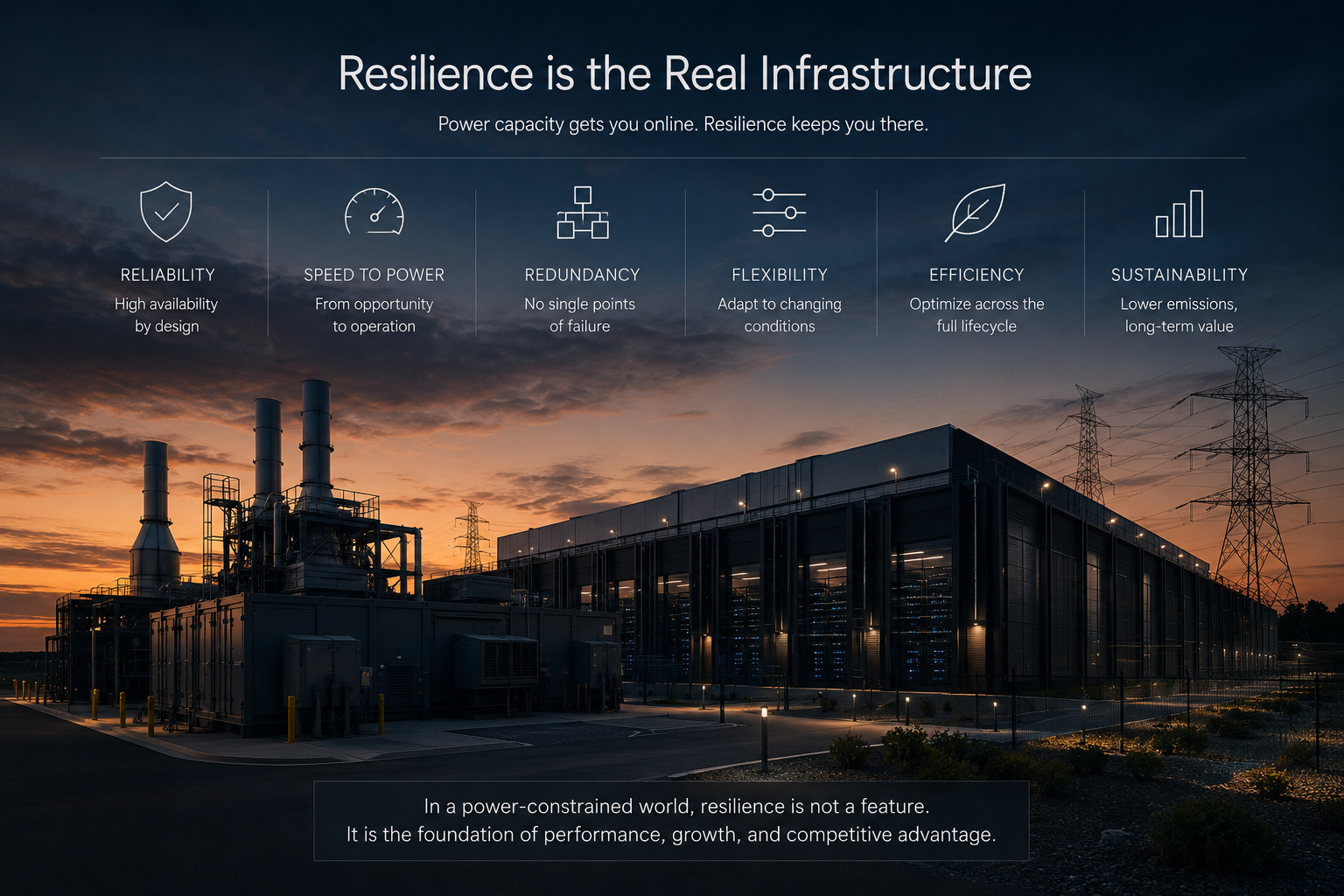
The rapid expansion of AI infrastructure is changing the energy conversation around data centers. For years, discussions around digital infrastructure growth focused primarily upon efficiency, renewable procurement and hyperscale expansion. Increasingly, however, a more fundamental issue is emerging beneath the surface: power availability itself.
Across many regions, developers are now encountering transmission constraints, interconnection delays, generation shortages and permitting bottlenecks that would once have been considered exceptional. In some markets, access to reliable power has become the defining factor shaping whether projects proceed at all.
At the same time, AI workloads are materially changing operational expectations. Higher rack densities, accelerated compute scaling and rising economic exposure to downtime are increasing the importance of resilient infrastructure design. The challenge is no longer simply about connecting megawatts to a site. It is about sustaining uptime within increasingly constrained and dynamic power systems. This distinction matters.
Much of the wider discussion surrounding data center energy demand still treats electricity as though it were an infinitely available commodity delivered through stable infrastructure systems. The reality is considerably more complex. Modern grids are evolving during a period of simultaneous electrification, renewable integration, transmission stress and accelerating digital demand growth. Infrastructure assumptions that appeared stable only a decade ago are increasingly being tested.
As a result, resilience is rapidly becoming one of the defining strategic considerations within AI infrastructure development.
Reliability Is a System Outcome
One of the most common misconceptions within infrastructure discussions is the assumption that reliability can be solved through individual equipment selection alone. In practice, highly resilient infrastructure is rarely the result of a single technology. It emerges from system architecture.
Availability is shaped by how generation systems, controls, switchgear, cooling systems, maintenance strategies, fuel arrangements, service capability and operational flexibility interact together over long periods of time. The resilience of a facility therefore depends not simply upon component specifications, but upon how effectively the wider system is designed to absorb disruption, maintenance events, load variation and infrastructure instability.
This is particularly important within AI-driven facilities where operating profiles may become increasingly dynamic. Infrastructure designed around static assumptions can struggle when confronted with variable workloads, partial-load operation or wider grid disturbances. In many cases, modularity and operational flexibility may ultimately prove as important as raw installed capacity.
This is one reason distributed and modular generation systems are receiving renewed attention within data center discussions. Rather than depending entirely upon large centralized infrastructure assets, operators are increasingly exploring architectures capable of delivering granular redundancy, flexible dispatch and staged deployment strategies. The objective is not merely to install power. It is to sustain operational continuity under real-world conditions.
The Grid Constraint Era
The modern data center industry evolved during a period where grid infrastructure was often assumed to expand broadly in line with demand growth. That relationship is now under pressure.
Across multiple geographies, utility connection timelines are extending significantly as transmission systems struggle to keep pace with electrification, renewable integration and rapidly rising compute demand. In parallel, permitting complexity, supply chain constraints and labor shortages are creating additional pressure across wider infrastructure delivery ecosystems. This creates an important shift in strategic thinking.
Historically, organizations could often optimize energy decisions primarily around cost or carbon intensity. Increasingly, however, deployment timelines themselves are becoming commercially critical.
For AI infrastructure developers, delayed energization can represent substantial financial exposure. Large-scale compute infrastructure cannot generate value until power is available. As a result, speed-to-power is becoming a strategic consideration alongside sustainability and operational efficiency. This does not remove the importance of decarbonization. But it does change the nature of the challenge.
The question increasingly becomes how to deploy reliable infrastructure quickly while preserving the ability to improve lifecycle carbon performance over time. This is a very different problem from the simplified energy debates that have often dominated public discussion.
Why Distributed Energy Has Re-entered the Conversation
The renewed discussion around distributed energy within data centers is sometimes portrayed as a temporary reaction to grid constraints.
In reality, the trend reflects a broader structural shift.
Distributed energy systems are increasingly being evaluated not simply as emergency backup assets, but as operational infrastructure capable of supporting resilience, deployment flexibility and wider system integration.
Modern power architectures can increasingly combine:
Modular generation
Battery energy storage systems
Hybrid microgrid controls
CHP and CCHP integration
Renewable energy inputs
Grid support functionality
Future fuel flexibility pathways
The result is a more adaptable infrastructure model capable of evolving over time.
Importantly, this does not necessarily imply permanent dependence upon any single technology pathway. One of the defining realities of modern energy infrastructure is uncertainty. Fuel economics, grid carbon intensity, regulation, battery economics and cooling technologies may all change materially over the operational life of a facility.
Infrastructure decisions being made today may remain operational for decades.
As a result, adaptability itself is becoming strategically valuable.
Partial-Load Reality Matters
Another important but often overlooked issue within infrastructure discussions is that data center systems rarely operate continuously under idealized conditions. Much of the public conversation around power infrastructure still focuses heavily upon nameplate capacity and theoretical peak specifications. In practice, however, real-world performance during partial-load operation, maintenance events, grid disturbances and variable compute demand may ultimately have greater operational importance. This is particularly relevant within modular engine-based architectures and hybrid power systems.
Distributed generation assets are designed to operate dynamically across varying operational conditions. When integrated effectively alongside advanced controls and battery systems, these architectures can provide important flexibility advantages while supporting redundancy and resilience objectives. This is one reason the relationship between power infrastructure and operational strategy is becoming increasingly interconnected. Resilience is not simply a procurement decision. It is an operational philosophy.
Lifecycle Thinking Beyond Static Carbon Snapshots
One of the most significant challenges within modern infrastructure debates is the tendency to evaluate systems using static snapshots rather than long-term transition pathways. Data center infrastructure may remain operational for 20 years or more.
Over that period, the surrounding energy ecosystem may change materially. Grid carbon intensity may decline. Battery systems may improve. Hydrogen pathways may mature. Renewable gas availability may expand. Waste heat recovery may become commercially valuable. Regulatory frameworks and carbon markets may evolve. This creates a strong argument for infrastructure strategies designed around flexibility and optionality rather than rigid assumptions.
The challenge is therefore not simply how to deploy infrastructure quickly today. It is how to deploy infrastructure capable of adapting tomorrow. This principle increasingly sits at the center of broader discussions surrounding resilient and lower-carbon AI infrastructure.
Beyond the Megawatt Conversation
The future of AI infrastructure will not be determined solely by how many megawatts can be connected to the grid. It will increasingly be shaped by how effectively operators integrate resilience, operational flexibility, lifecycle planning and infrastructure adaptability into long-term energy strategies. This represents a broader evolution in how digital infrastructure is being designed. Power is no longer simply a utility input sitting behind the data center. It is becoming one of the defining strategic variables shaping deployment speed, operational risk, sustainability trajectories and long-term infrastructure value.
The industry therefore faces a more complex challenge than simply securing additional generation capacity. It must increasingly design systems capable of navigating uncertainty itself. That is why the conversation around AI infrastructure is evolving beyond megawatts alone.
It is becoming a resilience discussion.