Sustainable Engineering and Powering the Future of Data Centers
Matt Vincent, Editor-in-Chief of Data Center Frontier, Toyebi Adedipe, and Ben Rapp - The Data Center Frontier Show, June 2024
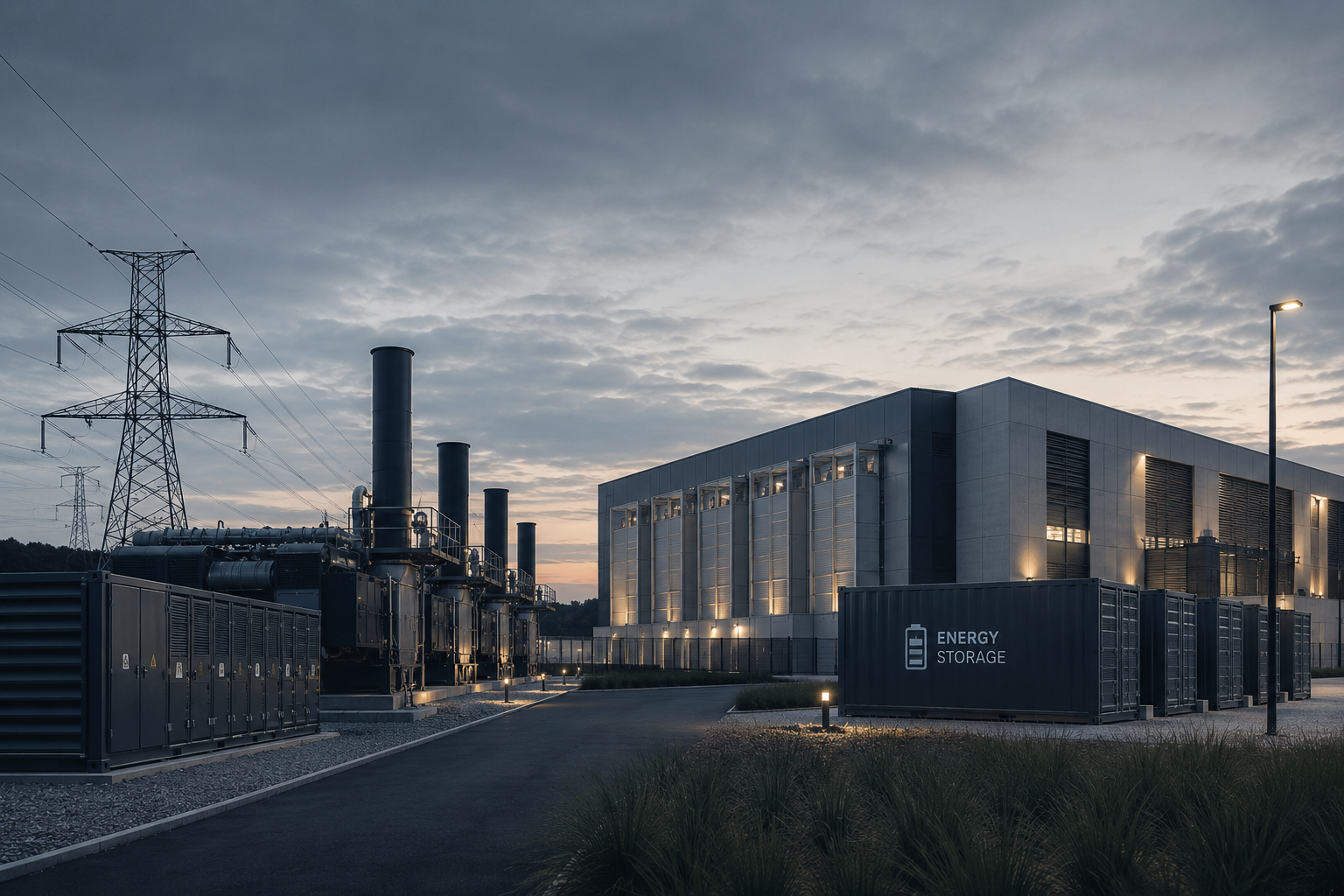
The data center industry increasingly speaks the language of sustainability. Carbon reduction targets, renewable energy procurement, water efficiency, energy optimization and lifecycle emissions are now central to infrastructure planning discussions. Yet beneath many of these conversations sits a more difficult engineering reality: digital infrastructure still has to work, continuously, under all operating conditions.
That tension is becoming more pronounced as AI accelerates demand for power density, scalability and deployment speed. The challenge is no longer simply reducing emissions. It is how to design electrical infrastructure capable of supporting exponential compute growth whilst preserving operational resilience. In practice, sustainability in data centers cannot be separated from reliability engineering. Systems that fail under stress, struggle with transient loads, or cannot scale operationally are not truly sustainable infrastructure regardless of their theoretical emissions profile.
This is why discussions around renewable integration in data centers must move beyond simplistic narratives. Renewable energy can and should play a major role in reducing lifecycle carbon intensity, but modern data center power systems increasingly require layered architectures capable of balancing reliability, flexibility and operational continuity simultaneously. The future is unlikely to be defined by single-technology solutions. Instead, it will be shaped by hybrid systems combining grid infrastructure, energy storage, intelligent controls, reciprocating engines, renewable generation and eventually lower-carbon fuels operating together as coordinated infrastructure ecosystems.
Importantly, resilience itself has become a sustainability issue. Large-scale outages, constrained grids, delayed utility connections and unstable power quality all carry significant economic and environmental consequences. Infrastructure designed purely around nameplate efficiency metrics often fails to capture operational realities such as partial-load performance, redundancy requirements, maintenance conditions and real-world dispatch flexibility. In mission-critical environments, infrastructure must be evaluated not only on theoretical efficiency, but on its ability to maintain uptime under dynamic operating conditions.
The industry is therefore entering a transition period where sustainability strategy increasingly depends on engineering pragmatism. The most effective pathways are likely to be phased rather than absolute: deploy reliable infrastructure first, optimize operational efficiency second and progressively decarbonize across the lifecycle of the asset as technologies, fuel pathways and grid conditions evolve. This requires thinking beyond individual technologies and toward long-term infrastructure trajectories.
Ultimately, sustainable data center power is not achieved by removing reliability from the equation. It is achieved by integrating sustainability into resilient system design from the outset. As AI infrastructure scales globally, the organizations that succeed will likely be those capable of treating reliability, scalability and decarbonization not as competing objectives, but as interconnected components of modern infrastructure engineering.
Watch the podcast:
Data Center Frontier Show – Sustainable Engineering and Powering the Future of Data Centers