Integrating Short-Lived Climate Pollutants Into Climate Action at COP26
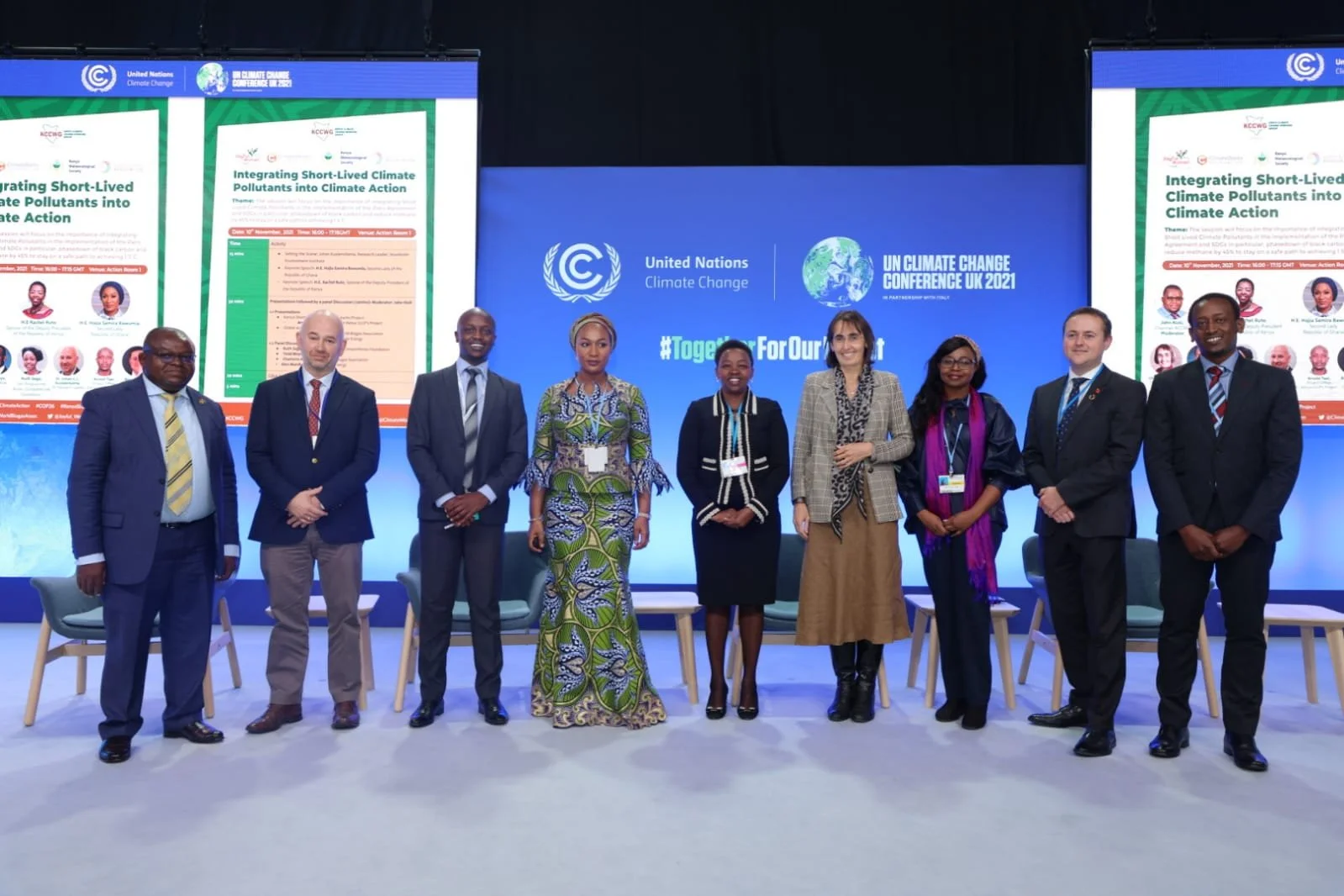
UN COP26 Panel With the Kenya Climate Change Working Group and World Biogas Association, Blue Zone, Glasgow with Charlotte Morton, Arnold Kipchumba, Rachel Ruto, Hajia Samira Bawumia and Alex Marshall
Last week I had the opportunity to participate in an official Blue Zone side event at the United Nations COP26 in Glasgow focused on short-lived climate pollutants (SLCPs), methane reduction, and the role that practical infrastructure solutions can play in accelerating climate action.
The session, hosted in partnership with the World Biogas Association and African climate stakeholders, brought together policymakers, industry representatives, and environmental organizations to discuss one of the most immediate opportunities available to reduce warming impact over the coming decades: methane emissions.
Much of the global climate discussion understandably focuses on long-term decarbonization pathways, electrification, and net zero targets. However, methane remains a critically important issue because of its near-term warming impact and the scale of emissions still being released from waste, agriculture, industrial processes, and energy systems around the world.
One of the key points I discussed during the session is that many methane emission sources are not theoretical future challenges. They already exist today across landfill sites, anaerobic digestion plants, wastewater facilities, furnaces, and associated petroleum gas operations. In many cases, these emissions can be captured and utilized using proven technologies that simultaneously support energy resilience and emissions reduction.
Gas engine technology has an important role to play within this discussion.
Where methane is captured rather than vented to atmosphere, it can be converted into useful power and heat through high-efficiency engine systems. This not only reduces the climate impact of methane release but also creates reliable onsite energy infrastructure capable of supporting industrial facilities, remote operations, municipalities, and critical infrastructure.
The discussion also covered the growing role of biogas upgrading systems, where raw biogas can be refined into biomethane or renewable natural gas suitable for injection into gas grids or use as a transport and industrial fuel. These systems provide another pathway to reduce methane emissions while creating long-term value from organic waste streams.
What became increasingly clear throughout COP26 is that the energy transition cannot rely on a single technology pathway. The future system will require a combination of electrification, renewable generation, energy storage, grid modernization, and practical low-carbon fuel solutions that can be deployed immediately at scale.
Importantly, methane mitigation often delivers dual benefits.
In addition to emissions reduction, many of these projects improve local air quality, support waste management strategies, strengthen energy security, and provide resilient distributed generation capacity in regions where grid infrastructure may be constrained or unreliable.
This is particularly relevant across parts of Africa and other rapidly developing regions where resilient infrastructure deployment remains critical to economic growth and industrial development.
The broader takeaway from the discussions in Glasgow is that climate action increasingly requires systems thinking rather than isolated technology debates. Capturing methane emissions and converting them into productive energy is not simply a waste management discussion or an energy discussion alone. It sits at the intersection of climate policy, infrastructure resilience, energy access, and industrial development.
COP26 demonstrated that momentum around methane reduction is accelerating rapidly. The challenge now is translating ambition into deployment.
Fortunately, many of the technologies required already exist today.