AI Data Centers, Speed-to-Power, and the Net Zero Reality
Alejandro De Diego, Modo Energy Transition Podcast, with Transmission, at Reuters Energy Transition Conference, Houston 2025.
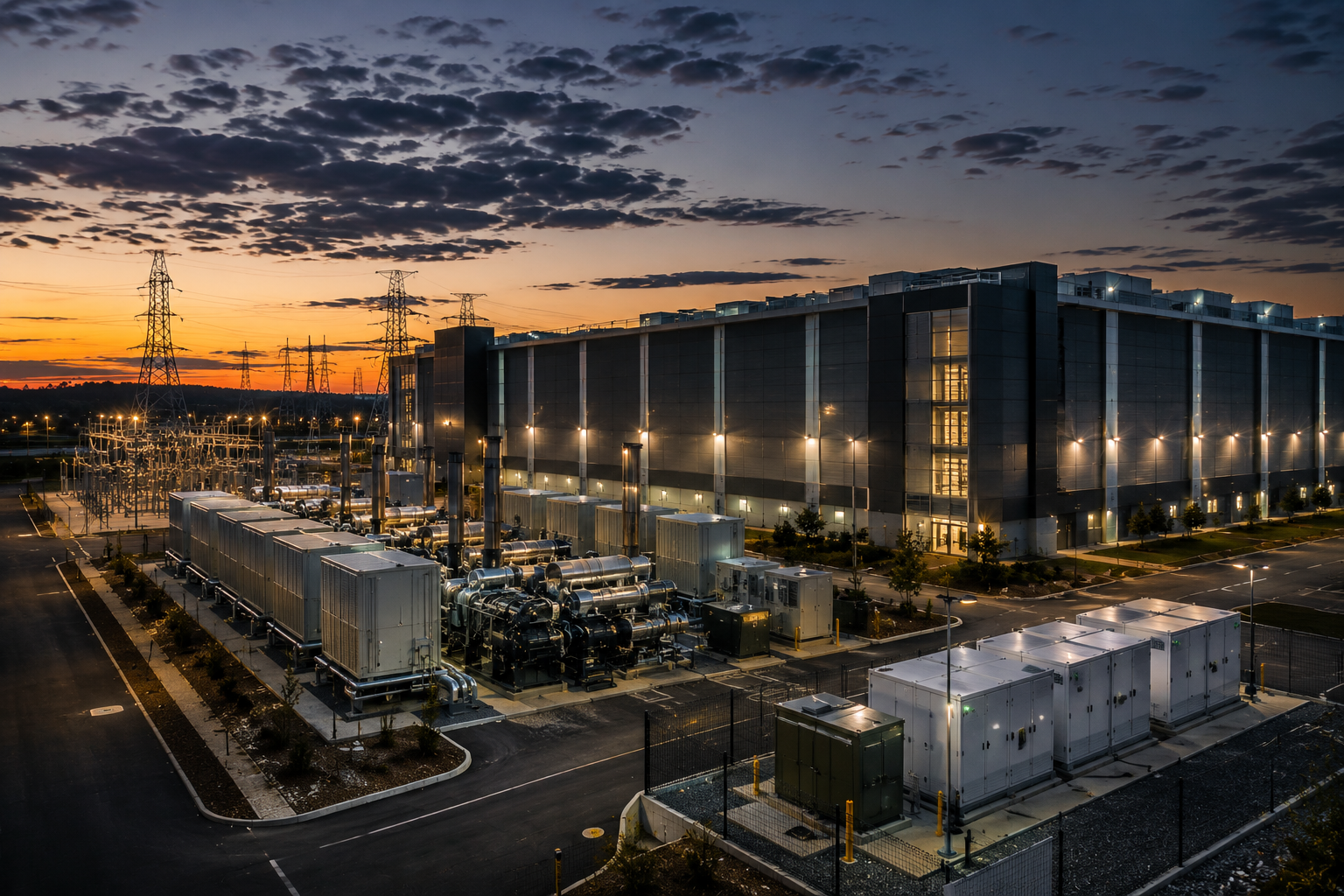
Data center onsite power solutions are evolving.
One of the more interesting discussions emerging around AI infrastructure is the growing tension between deployment speed and long-term decarbonization strategy.
As hyperscale and AI-driven demand accelerates, the industry is being forced into a difficult reality: many regions simply cannot deliver grid capacity quickly enough to support the pace of new development. The result is a renewed focus on behind-the-meter generation, hybrid power systems, microgrids, gas engines, and flexible infrastructure capable of shortening time-to-power while maintaining operational resilience.
That creates an uncomfortable debate.
On one side sits the urgency of deployment. On the other sits the pressure to decarbonize rapidly and visibly.
In practice, however, the challenge is rarely binary.
The real infrastructure question is not whether systems are “grid connected” or “off grid,” nor whether one technology is permanently “good” or “bad.” It is whether infrastructure is being designed with enough flexibility to evolve over its operational life. That means thinking beyond initial fuel choice and toward lifecycle trajectory, optionality, efficiency, hybridization pathways, and future integration with lower-carbon energy systems.
This is where the discussion becomes more nuanced than many headlines suggest.
A well-designed distributed energy architecture may initially deploy natural gas generation for speed, resilience, and grid independence — while still preserving future pathways for renewable gas integration, CHP/CCHP efficiency gains, battery integration, thermal optimization, demand flexibility, and progressively lower operational emissions over time.
Equally, a nominally “fully electric” project may still carry hidden dependencies on constrained grids, curtailment, peaking generation, or transmission limitations elsewhere in the system.
The industry increasingly needs to assess infrastructure not simply through static labels, but through system-wide outcomes across reliability, cost, scalability, and long-term decarbonization.
This recent discussion from Modo Energy explores several of these tensions particularly well, especially around AI data center growth, electricity market pressures, and the practical realities emerging around power infrastructure deployment. It’s worth a listen for anyone involved in digital infrastructure, distributed energy, or long-duration energy transition planning.
Podcast / Video:
Speed to Power vs Net Zero: The Data Center Dilemma