Old Tech, New Pressures: Why Mature Power Technologies Are Returning to the Center of AI Infrastructure
Joe Batir, Energy Transition Solutions Podcast at Reuters Energy Transition Event, Houston, 2025.
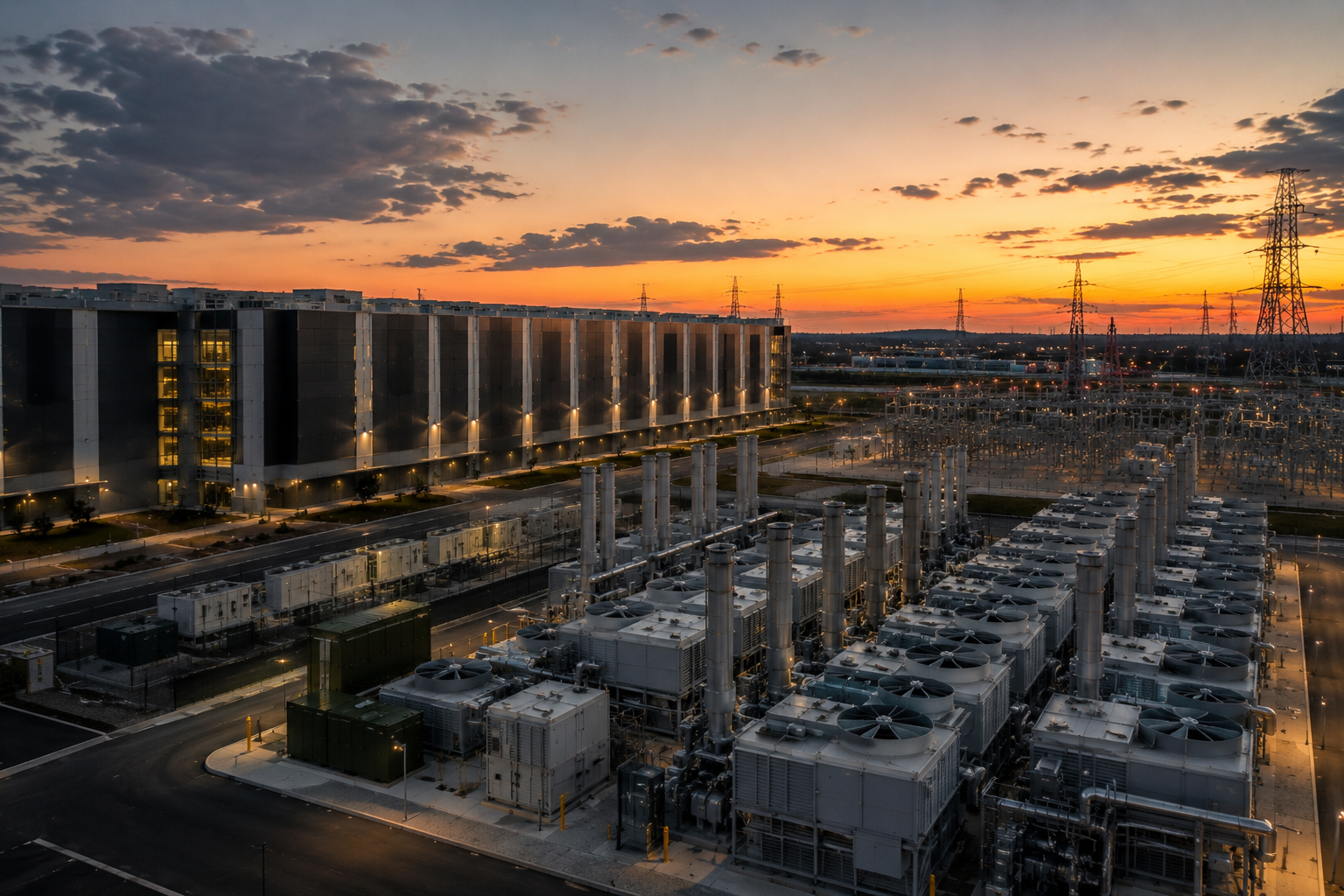
A hypothetical onsite power system at a data center
One of the more interesting shifts now emerging in AI infrastructure is the reappraisal of technologies that, until recently, many considered transitional, legacy, or incompatible with long-term net zero ambitions.
The reality facing the sector is more complex.
As AI-driven electricity demand accelerates, the conversation is moving away from theoretical future-state energy systems and back toward the practical challenge of delivering resilient, scalable power infrastructure within commercially relevant timelines. In many regions, grid expansion simply is not moving fast enough to match the pace of data center development.
That pressure is forcing a broader reassessment of how infrastructure is valued.
Technologies such as gas engines, CHP, hybrid microgrids, thermal recovery systems, and distributed generation are increasingly being reconsidered not because the industry has abandoned decarbonization ambitions, but because reliability, deployment speed, operational flexibility, and system resilience have become immediate constraints.
This is where the discussion becomes more nuanced than simplistic “old versus new” technology narratives.
Much of the infrastructure now being revisited was never technically obsolete. In many cases, these systems were displaced by policy direction, fuel perception, market timing, or assumptions about grid evolution. Yet many still offer highly valuable characteristics for modern digital infrastructure: modularity, dispatchability, thermal utilization opportunities, black-start capability, operational redundancy, and compatibility with hybrid architectures.
The question therefore is not whether infrastructure is “old” or “new.”
It is whether infrastructure can support the operational realities of the next decade while retaining flexibility for the decades that follow.
That increasingly points toward hybridization rather than technological absolutism.
The future of AI infrastructure is unlikely to be defined by a single technology pathway. More likely, it will involve layered systems combining centralized grids, distributed generation, battery storage, thermal optimization, renewable integration, flexible controls, and progressively lower-carbon fuels over time.
This discussion is explored particularly well in this recent podcast conversation featuring Alex Marshall, focused on the growing role of mature infrastructure technologies in supporting modern energy transition challenges and AI-era power demand.
For anyone involved in AI infrastructure, resilient energy systems, or long-term power strategy, it’s a worthwhile discussion because it moves beyond ideology and back toward the engineering, operational, and commercial realities shaping deployment decisions.