Hybrid Energy Strategies Are Re-entering the Data Center Conversation
Tam Pledger and Benn Rapp, Data Center Dynamics Podcast, 2025, Sponsored by Rehlko.
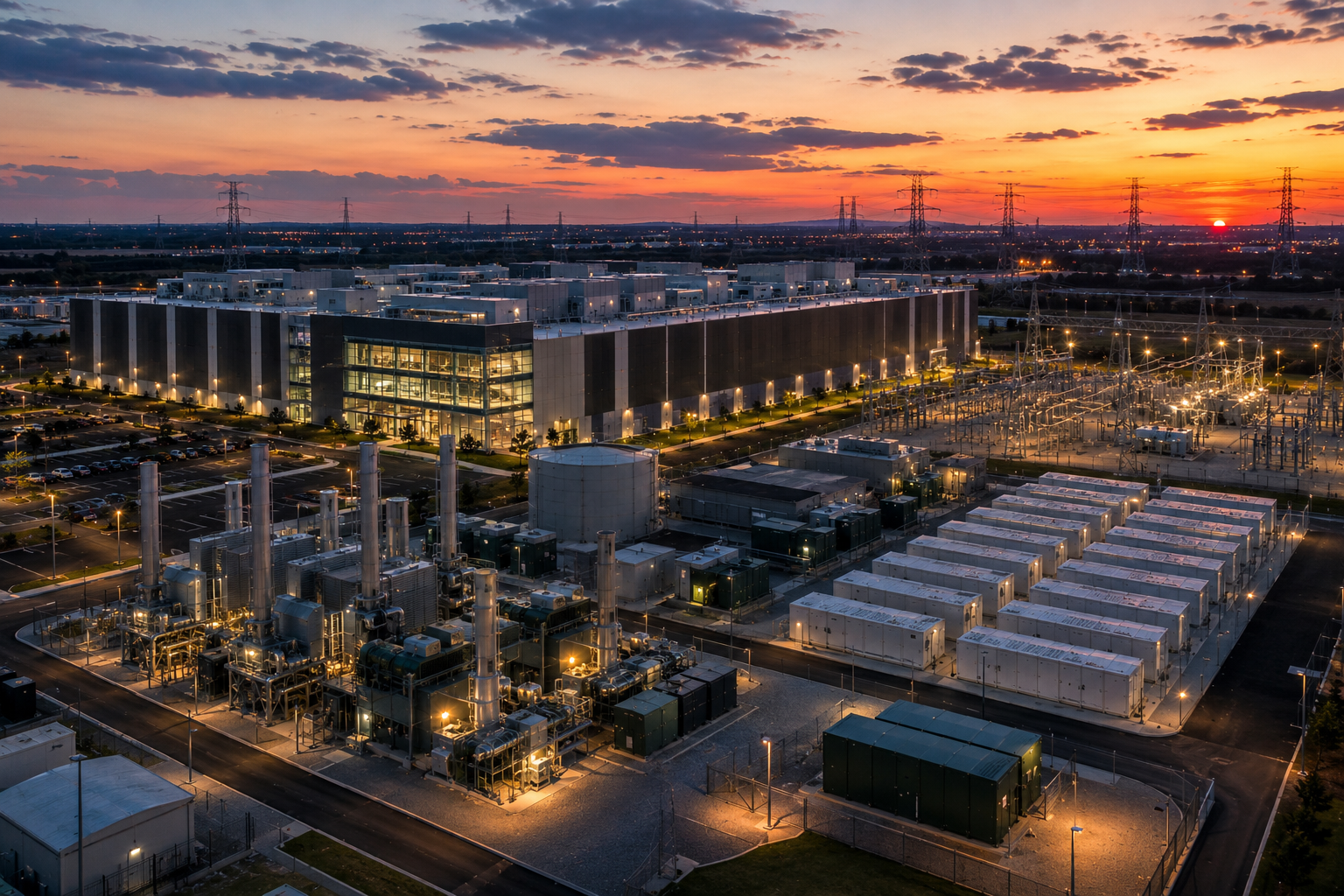
One of the most important shifts now emerging in AI infrastructure is the growing recognition that resilience is no longer simply a question of backup systems or redundant utility feeds.
It is increasingly becoming an architectural question.
As AI workloads scale, power density rises, and deployment timelines compress, many developers are encountering the same underlying challenge: the electrical grid alone is often struggling to keep pace with the speed, flexibility, and reliability requirements modern digital infrastructure now demands.
That reality is beginning to reshape how the industry thinks about energy infrastructure.
For years, much of the discussion around data center decarbonization centered on a relatively linear transition narrative: increased grid electrification, expanding renewable penetration, and gradual displacement of on-site thermal generation. While that trajectory remains important, the practical realities now facing hyperscale and AI infrastructure are proving more complicated.
Grid connection delays are extending into multiple years in some markets. Transmission upgrades are struggling to match demand growth. Electricity market volatility is increasing. Meanwhile, AI infrastructure cannot simply wait for perfect future conditions to emerge.
The result is a growing reappraisal of hybrid energy architectures.
Increasingly, resilience is being viewed not as a single technology choice, but as the coordinated orchestration of multiple infrastructure layers: centralized grids, distributed generation, battery energy storage, intelligent controls, thermal optimization, and flexible operational strategies working together as integrated systems.
That distinction matters.
The future of resilient infrastructure is unlikely to be defined by purely centralized or purely distributed models. More likely, it will involve increasingly dynamic hybrid architectures capable of balancing reliability, deployment speed, operational flexibility, and long-term decarbonization pathways simultaneously.
This is particularly relevant in AI-ready data centers, where infrastructure design assumptions are evolving rapidly.
Large language model training clusters, high-density compute environments, and advanced liquid cooling systems are all increasing both the scale and sensitivity of power demand. In this environment, traditional distinctions between “primary power,” “backup power,” and “grid support” are beginning to blur.
Infrastructure is becoming more integrated, more operationally dynamic, and more strategically important.
That is also why mature technologies such as gas engines, CHP/CCHP systems, microgrids, and distributed generation are returning to the conversation. Not because the industry is abandoning decarbonization ambitions, but because these systems can provide characteristics increasingly valued within constrained infrastructure environments: dispatchability, modular scalability, thermal utilization opportunities, black-start capability, and deployment speed.
The key question therefore is not whether one technology “wins.”
It is whether infrastructure is being designed with sufficient flexibility to evolve over its operational life.
A well-designed hybrid architecture may initially prioritize resilience and speed-to-power while still preserving future pathways for lower-carbon fuels, battery integration, thermal optimization, renewable integration, and progressively lower operational emissions over time.
Equally, purely grid-dependent strategies may still carry hidden dependencies on transmission bottlenecks, regional generation constraints, curtailment risk, or wider grid instability elsewhere in the system.
The industry increasingly needs to evaluate infrastructure not through simplistic labels, but through system-level outcomes across reliability, scalability, operational resilience, economics, and lifecycle transition capability.
This recent discussion from Data Center Dynamics explores many of these themes particularly well, especially around hybrid energy systems, resilience strategy, and the changing operational realities emerging around AI-ready data center infrastructure.
For anyone involved in AI infrastructure, distributed energy systems, or long-term power strategy, it is a worthwhile discussion because it moves beyond simplistic technology narratives and focuses instead on the increasingly complex realities shaping modern infrastructure deployment.
Further discussion on AI infrastructure, resilience and distributed energy strategy can also be found via Data Center Dynamics (DCD) interviews and commentary.
Watch the Discussion
Rethinking resilience: Hybrid energy strategies for AI‑ready data centers